
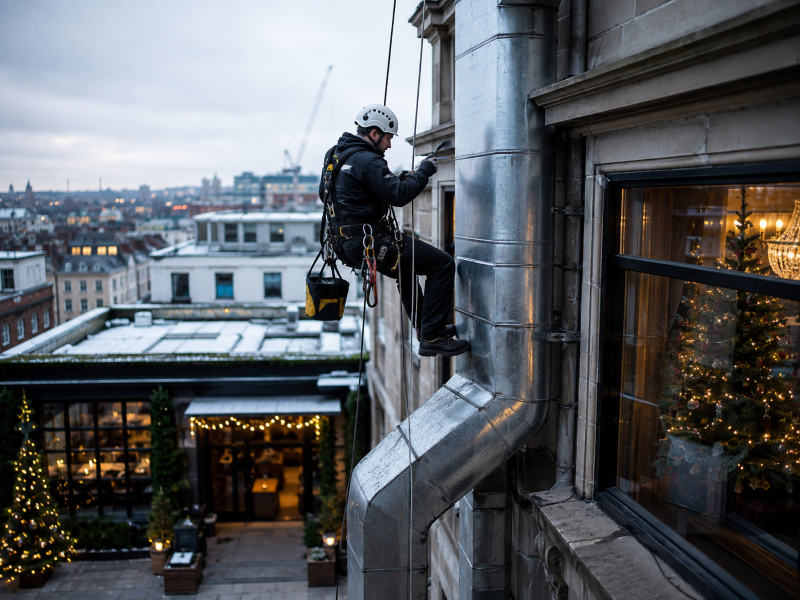
Christmas can place some of the greatest operational pressure of the year on commercial kitchens, making rope access ductwork services particularly valuable where extract systems include high-level ducts, external routes or vertical risers that are difficult to inspect and clean. Hotels, restaurants, pubs, entertainment venues and hospitality sites may extend service hours, increase covers and operate cooking equipment for longer periods, often with fewer opportunities for maintenance downtime.
For facilities, building and estates managers the weeks before the festive trading period provide an important opportunity to review the condition of the entire kitchen extract system – not simply the canopy and ductwork that are easy to see and reach. High-level sections can contain grease deposits that remain hidden, particularly where previous cleaning contractors were unable to gain appropriate access.
UK fire authorities regularly highlight grease accumulation within commercial kitchen extraction systems as a potential fire risk. Where contaminated ductwork extends through a building, a fire originating within the kitchen can potentially spread beyond the immediate cooking area through the extract route.
Professional rope access ductwork services can help facilities teams investigate these difficult sections before seasonal cooking volumes increase. Specialist technicians can access high-level and external ductwork, inspect risers, support internal cleaning and install additional access panels where existing openings do not provide sufficient access.
This FAQ guide explains what facilities managers should consider before peak Christmas trading and why extract-system readiness should include the sections that are hardest to reach.
Quick answer: why use a rope access ductwork service before Christmas?
Heavy Christmas trading can increase the amount of grease-laden vapour passing through a kitchen extract system.
If inaccessible parts of the system already contain established grease deposits, increased cooking activity may add further contamination to those areas.
A pre-Christmas rope access ductwork inspection can help facilities managers establish whether:
- The complete extract route has historically been accessed
- Vertical risers have been internally inspected
- High-level sections have been cleaned
- Suitable access panels are installed
- Cleaning certificates accurately reflect the areas completed
- Previously inaccessible sections still require attention
Potential contamination can then be investigated before kitchens enter their busiest period.
Why can Christmas trading increase grease accumulation?
A commercial kitchen’s operating profile may change significantly during November and December.
Restaurants may accommodate larger bookings and additional sittings. Hotels may simultaneously operate restaurants, banqueting kitchens and room service. Pubs and event venues may host functions alongside normal service.
This can mean:
- Longer cooking periods
- Higher numbers of covers
- More frying and grilling
- Greater quantities of grease-laden vapour
- Reduced maintenance windows
- Extended extract-system operating hours
- More pressure on filters and fans
- Higher consequences if an unexpected shutdown occurs
Christmas does not automatically make an extract system unsafe. However, increased use can accelerate contamination in a system that already contains grease deposits.
Facilities teams should therefore establish the condition of their ductwork before, rather than during, peak trading.
Why is hidden grease inside kitchen extract ductwork a concern?
Grease deposited inside extract ductwork is combustible.
Should ignition occur within or enter a contaminated extraction system, grease deposits can contribute to fire spread through sections of ductwork beyond the kitchen itself.
This is why UK fire-safety guidance places importance on effective maintenance of commercial kitchen extraction systems.
The crucial facilities-management question is therefore not simply:
“Has the kitchen extract system been cleaned?”
A more useful question is:
“Which parts of the kitchen extract system were actually accessed, inspected and cleaned?”
That distinction becomes particularly important where the system includes high-level ductwork and long vertical risers.
How does a rope access ductwork service help identify inaccessible areas?
Kitchen extraction systems are often designed primarily around ventilation performance rather than future cleaning access.
A duct route may leave the kitchen and travel through:
- Vertical service risers
- Lightwells
- External façades
- Restricted courtyards
- Roof plant areas
- Internal voids
- High-level service spaces
- Multiple storeys
A conventional cleaning team may have excellent access to the canopy and lower ductwork but no practical means of reaching sections several floors above.
Professional rope access ductwork methods can provide a controlled means of accessing these locations without automatically requiring extensive scaffolding.
Facilities managers can learn more about the specialist access methods available through our rope access services page.
Once a technician can safely reach the duct route, the next question is whether suitable internal access is available for inspection and cleaning.
What should facilities managers look for in historic cleaning documentation?
Before arranging new works, review previous kitchen extract records carefully.
Cleaning certificates, photographs and associated documentation may reveal that some areas were repeatedly excluded.
Look for wording such as:
- No access
- Area inaccessible
- Riser not inspected
- Access panel required
- High-level section excluded
- External duct not accessed
- Fan inaccessible
- Further access required
- Partial clean
- Restricted access
The photographic evidence can be equally revealing.
If a multi-storey extract riser is present but every photograph relates to the canopy and lower ductwork, it is reasonable to ask what evidence exists for the condition of the riser itself.
Repeated access limitations should not become a permanent feature of successive cleaning cycles.
Does a dated cleaning certificate confirm that every section was cleaned?
Not necessarily.
A dated kitchen extract cleaning certificate or report should certify the sections that were actually accessed, inspected and cleaned at the time of the work.
It should not represent inaccessible parts of the system as complete.
This distinction is particularly important because facilities teams may retain cleaning certificates within:
- Fire-safety documentation
- Building-maintenance records
- Insurance records
- Compliance documentation
- Contractor records
- Audit files
The certificate and supporting information should make the scope clear.
Useful information may include:
- System identification
- Date of cleaning
- Areas accessed
- Sections cleaned
- Access panels used
- Access panels installed
- Areas remaining inaccessible
- Observations or defects
- Supporting photographs
For facilities managers precise certification provides much greater value than a general statement that the extract system was “cleaned”.
What should a pre-Christmas rope access ductwork audit include?
A useful audit should establish what is actually known about the complete extract route.
The review may include:
- Existing ductwork drawings
- Previous cleaning certificates
- Historic inspection photographs
- Access-panel locations
- Vertical riser routes
- External duct sections
- Extract-fan access
- Changes in duct direction
- Previous no-access observations
- Visible condition of external ductwork
The results can then be used to determine whether further inspection, cleaning or access-panel installation is required.
A pre-Christmas rope access ductwork audit can be particularly valuable when a facilities manager has recently inherited responsibility for a property and cannot confidently establish what earlier contractors were able to reach.
Why are vertical kitchen extract risers particularly important?
Vertical risers can carry grease-laden extract air through several storeys before reaching a roof-level fan or discharge point.
Their location can make them particularly difficult to maintain.
A riser may run through an area where:
- There is no permanent working platform
- Ground-based access equipment cannot reach it
- The surrounding space is restricted
- Scaffolding would obstruct operational areas
- There is limited ground space
- There are few suitable inspection openings
Rope access can potentially position technicians alongside these high-level duct sections.
However, reaching the outside of a duct is only part of the solution.
Suitable access panels are also necessary if internal surfaces are to be inspected and cleaned effectively.
What happens when a riser does not have enough access panels?
Additional panels may need to be installed.
Internal ductwork cannot be properly inspected or cleaned where equipment cannot reach the relevant surface.
Access panels may be necessary near:
- Changes of direction
- Vertical risers
- Long uninterrupted duct runs
- Branches
- Fans
- Dampers
- Restricted shafts
- High-level external sections
- Areas previously identified as inaccessible
Combining rope access ductwork inspection with access-panel installation can solve both an immediate access problem and a recurring maintenance issue.
Once suitable panels are available, future contractors should have a better opportunity to inspect and clean the same sections during subsequent maintenance cycles.
Why resolve access problems before peak Christmas trading?
Finding an access problem is only the beginning.
If facilities managers leave the inspection until December trading is already at full capacity, there may be limited opportunities to arrange:
- Additional access-panel installation
- Further internal inspection
- Remedial duct cleaning
- Fan access
- Repairs
- System shutdowns
- Follow-up certification
Identifying the issue earlier provides more time to complete any necessary work before seasonal demand increases.
This is particularly important for hotels, restaurants and event venues where December maintenance windows may already be extremely limited.
Can a rope access ductwork service take place while the building remains occupied?
Often, yes.
Rope access can provide a relatively small ground-level footprint compared with extensive scaffolding, making it useful for operational commercial properties.
However, the extract system itself may still need to be safely isolated while technicians:
- Open access panels
- Inspect internal surfaces
- Clean ductwork
- Install new panels
- Work near fans or mechanical equipment
The wider property may therefore remain operational while a particular kitchen or extraction system follows a planned shutdown.
Work can potentially be scheduled:
- Overnight
- Between services
- Before breakfast
- After evening service
- During planned kitchen closure periods
- One system at a time
- In phased sections
The objective is to complete necessary maintenance while minimising avoidable disruption.
Is a rope access ductwork service only relevant to restaurants?
No.
Any building containing a busy commercial kitchen and difficult-access extraction route may require specialist access.
Examples include:
- Hotels
- Pubs
- Food halls
- Shopping centres
- Hospitals
- Universities
- Stadiums
- Entertainment venues
- Event facilities
- Care settings
- Contract catering environments
- Mixed-use developments
Multi-storey buildings can present particular challenges because kitchen extract systems may travel past other occupied parts of the property before reaching roof level.
What warning signs suggest a high-level riser should be investigated?
An inaccessible riser may produce no obvious symptoms, which is one reason documentation is so important.
However, facilities managers should investigate where:
- Previous certificates repeatedly mention inaccessible sections
- There are gaps in the cleaning history
- Photographs only cover the canopy and lower ductwork
- Long sections of duct contain no obvious access panels
- Grease staining is visible around joints
- Grease appears close to the extract fan
- Cooking odours are detected around the duct route
- Different contractors have reported conflicting system conditions
- The kitchen has increased its operating hours
- Cooking methods have changed
- Capacity has expanded
- The site has recently changed management
Lack of visible contamination at lower level does not confirm that an inaccessible high-level riser is clean.
Can the canopy be clean while the riser remains contaminated?
Yes.
Different areas of an extraction system can accumulate deposits at different rates.
Factors affecting contamination include:
- Air velocity
- Duct orientation
- Temperature
- Surface condition
- Changes of direction
- Cooking method
- Filtration efficiency
- Accessibility during previous cleaning
A clean canopy therefore does not demonstrate that a vertical riser several floors higher is in the same condition.
This is a key reason why a rope access ductwork inspection should consider the complete extract route rather than relying solely on visible sections.
Should Christmas trading trigger a review of cleaning frequency?
It can provide a useful review point.
Cleaning frequency should reflect actual use and contamination rather than relying indefinitely on a historic schedule.
Facilities managers should reassess the maintenance programme where a kitchen has:
- Extended opening hours
- Installed additional cooking equipment
- Changed menu style
- Increased frying or grilling
- Added banqueting operations
- Expanded food production
- Substantially increased customer numbers
Christmas may represent a temporary increase rather than a permanent operational change, but the system should still enter that period from an appropriately maintained baseline.
What does Christmas kitchen extract readiness actually mean?
It should mean more than arranging a quick clean of visible kitchen surfaces immediately before December.
For facilities teams a Christmas-ready extract system should involve a reasonable understanding of:
- The complete duct route
- Current cleaning status
- High-level riser condition
- Access-panel provision
- Previous inaccessible areas
- The most recent cleaning date
- What the dated certificate actually covers
- Outstanding remedial recommendations
- Changes in kitchen use
A documented understanding of the system provides a stronger basis for maintenance decisions than simply assuming that a previous cleaning visit covered everything.
How can a compliance audit help?
A compliance audit provides an opportunity to compare documentation with the physical extract-system layout.
The audit can help identify discrepancies such as:
- A riser shown on drawings but absent from cleaning photographs
- Certificates that do not define inaccessible areas
- Missing access panels
- Sections without recent inspection evidence
- Historic recommendations that were never completed
- Changes to the extraction system
- New cooking equipment affecting system use
The purpose is not simply to generate another document.
It is to establish whether the maintenance history accurately represents the system currently installed.
What should photographic evidence show?
Photographs are particularly valuable for rope access ductwork because facilities managers may never physically see the areas being inspected.
Useful evidence can include:
- External riser locations
- Access-panel positions
- Internal duct surfaces before cleaning
- Grease deposits
- Obstructions
- Failed seals
- Access limitations
- Internal surfaces after cleaning
- Newly installed access panels
- Fan connections
- Remaining inaccessible areas
Images should be clearly associated with the relevant duct sections rather than presented as generic examples.
Can a rope access inspection identify building-maintenance issues too?
Potentially, where this forms part of the agreed scope.
A technician positioned alongside external ductwork may observe:
- Corrosion
- Failed duct seals
- Loose supports
- Damaged insulation
- Grease leakage
- Weather damage
- Panel deterioration
- Bird activity
- Problems with surrounding building fabric
These observations can be photographed and passed to the facilities team for further assessment.
This can make a rope access ductwork visit useful within a wider planned-maintenance programme.
Can bird activity create problems around high-level extract systems?
Yes.
External ductwork and roof-level plant can provide perching or nesting locations.
Bird activity may result in:
- Fouling
- Nesting materials
- Restricted maintenance access
- Blocked drainage
- Contamination around plant
- Damage to insulation or surrounding materials
Where required, high-level pest-control measures can be considered alongside ductwork inspection and building maintenance.
Combining compatible tasks can reduce repeat access mobilisation.
Can duct cleaning, access panels and compliance auditing be combined?
Yes, and this can be one of the most practical approaches for facilities managers.
A planned project may include:
- Reviewing historic certificates
- Mapping difficult-access ductwork
- Inspecting the vertical riser
- Assessing internal contamination
- Installing required access panels
- Completing duct and riser cleaning
- Recording before-and-after evidence
- Identifying remaining limitations
- Issuing an accurate dated cleaning certificate for completed areas
This creates a logical progression from identifying the access problem to resolving it.
Can several rope access services be completed during the same mobilisation?
Where appropriate, yes.
The same mobilisation may potentially incorporate:
- Rope access ductwork inspection
- Duct and riser hygiene
- Access-panel installation
- Compliance auditing
- External duct condition inspection
- Building-maintenance observations
- Bird-proofing assessments
- DOFF cleaning
Combining compatible services can help facilities teams reduce repeated set-up costs and minimise disruption.
Is rope access always preferable to scaffolding?
No.
Rope access can be extremely efficient for targeted inspections, maintenance and short-duration work where access is restricted.
However, the access method should always be selected according to:
- Building configuration
- Duration of works
- Equipment requirements
- Number of technicians required
- Load requirements
- Anchor arrangements
- Rescue planning
- Public protection
- Ground-level restrictions
Some projects may be more appropriately completed using scaffolding, mobile platforms or another access solution.
A professional survey should determine the safest and most proportionate method.
What should facilities managers ask before commissioning pre-Christmas rope access ductwork services?
Useful questions include:
- Has the entire extraction route historically been accessed?
- Which sections were excluded from previous cleaning?
- Does the dated certificate or report identify these limitations?
- Is there photographic evidence from the vertical riser?
- Are sufficient access panels installed?
- When was the high-level ductwork last internally inspected?
- Has kitchen activity increased since the previous clean?
- Are remedial works outstanding?
- Can additional panels be installed before Christmas?
- Can work take place around operating hours?
- Will the completed documentation identify exactly what was cleaned?
These questions help facilities managers distinguish between a system that has been regularly serviced and a system that has actually been comprehensively accessed.
When should pre-Christmas kitchen extract inspections be arranged?
Ideally, facilities managers should leave sufficient time for remedial work after the initial inspection.
An assessment may identify:
- Heavy grease deposits
- Missing access panels
- Previously inaccessible risers
- Damaged ductwork
- Fan-access difficulties
- Incomplete historic cleaning
These findings cannot necessarily be resolved during the initial visit.
Planning ahead allows time to arrange the appropriate cleaning, installations or repairs before kitchens enter the busiest trading period.
It also provides greater flexibility for scheduling overnight and low-disruption work.
Why choose Rope Access 24 Seven?
Rope Access 24 Seven provides specialist access services for complex commercial buildings across the UK.
Our services include:
- Rope access ductwork inspections
- Duct and riser hygiene
- Compliance audits and condition inspections
- Access-panel installation
- Building maintenance
- DOFF cleaning
- High-level pest-control solutions
Our highly skilled technicians are IRATA-qualified, and each project is planned around the building, operational environment and required scope.
We provide flexible scheduling, 24/7 operational support, free expert advice and free site surveys.
Arrange a pre-Christmas rope access ductwork survey
The busiest trading period of the year is not the ideal time to discover that several storeys of a kitchen extract riser have never been properly inspected or cleaned.
A pre-Christmas survey can help determine:
- Which areas have historically been accessed
- Whether the vertical riser has been cleaned
- Where access panels are missing
- Whether hidden grease deposits require investigation
- What existing cleaning certificates actually cover
- Whether remedial work is required before peak trading
- How works can be scheduled around kitchen operations
For facilities, building and estates managers the objective is simple: establish what is actually happening inside the entire extract route before cooking volumes increase.
Contact our expert Operations Team to discuss a rope access ductwork service, access-panel installation or a pre-Christmas compliance audit.
📞 Call our Operations Team for more information: 0203 640 8247
📧 Email your enquiry: info@24sevengroup.co.uk
For information about our full range of services use these helpful website links Industrial Rope Access Services, Rope Access Building Maintenance, DOFF Cleaning and Rope Access Pest Control.