
Quick answer
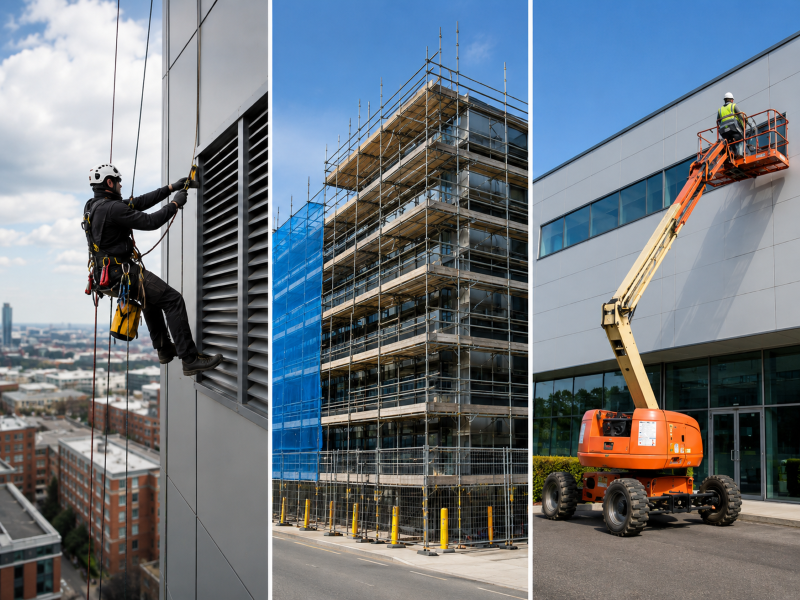
Industrial rope access services provide a flexible access method for commercial, industrial and difficult-access building works where scaffolding or mobile elevated work platforms (MEWPs) may be costly, disruptive or impractical. Scaffolding may still be suitable for long-duration projects and heavy works, while MEWPs can be useful where ground conditions and reach are suitable. However, for inspections, ductwork and riser access, façade maintenance, bird control, cleaning, compliance audits and targeted repairs, rope access can often reduce mobilisation time, ground-level disruption and access costs.
Why access method matters before maintenance begins
Facilities managers and building managers rarely face a simple height problem. More often, they face a combination of access restrictions, live building operations, tight budgets, compliance pressure and time-sensitive maintenance requirements.
A high-level defect may need inspecting. A ductwork or riser route may need access. Bird fouling may be affecting a façade. A gutter may be blocked above a busy entrance. A building may need cleaning, but scaffolding would block the pavement for weeks.
This is where industrial rope access services offer a practical alternative. Rather than building a temporary structure or positioning large mechanical equipment, rope access technicians use specialist rope systems to reach the work area directly.
The result can be a faster, cleaner and more adaptable way to complete suitable commercial building tasks.
How industrial rope access services compare with traditional access
Scaffolding, MEWPs and rope access all have a place in building maintenance. The right choice depends on the task, site conditions, timescale, budget and risk profile.
A good facilities team should not choose an access method by habit. It should compare the options based on what the building actually needs.
Industrial rope access services are often strongest where the task is short, targeted, high-level, difficult to reach or spread across several isolated points on the building.
Scaffolding is often strongest where the project needs a fixed working platform for a longer period.
MEWPs can be useful where there is suitable ground space, stable access routes and a clear line of reach to the work area.
The practical question is not “which method is best overall?” It is “which method is proportionate to this building, this task and this level of disruption?”
How to compare industrial rope access services with scaffolding and MEWPs
1 Assess the task duration
The length of the project is one of the first factors to consider.
Scaffolding may be appropriate for:
- Long-duration façade refurbishment
- Multi-trade construction works
- Large-scale masonry repairs
- Projects requiring repeated heavy material movement
- Extended works across the same elevation
MEWPs may be suitable for:
- Short works where ground access is clear
- External repairs at reachable heights
- Work above flat, stable surfaces
- Tasks that require a powered platform
Industrial rope access services may be better suited to:
- Short-duration inspections
- Targeted repairs
- Compliance audits
- Ductwork and riser access
- High-level cleaning
- Bird control installation
- Façade defect checks
- Gutter and drainage inspections
Where the task only takes a short period to complete, erecting scaffolding may be disproportionate. Rope access can often place technicians exactly where they are needed without the long lead-in time associated with traditional infrastructure.
2 Review ground-level restrictions
Ground conditions often decide whether scaffolding or MEWPs are practical.
Building managers should consider:
- Busy pedestrian walkways
- Narrow pavements
- Retail entrances
- Hotel drop-off points
- Loading bays
- Restricted courtyards
- Poor ground bearing capacity
- Limited vehicle access
- Parking restrictions
- Public highway constraints
Scaffolding and MEWPs both need ground space. They may require permits, barriers, delivery access, exclusion zones or pavement licences.
Industrial rope access services can often reduce the need for large ground-based access equipment. Technicians are usually rigged from above or from suitable structural points, allowing works to take place with a smaller ground footprint.
This can be especially valuable for city-centre buildings, occupied commercial properties, healthcare sites, hotels, universities, residential blocks and retail premises where public access needs to remain open.
3 Consider disruption to building users
Access equipment can affect how a building operates.
Scaffolding may block windows, change the appearance of a building, restrict entrances or create security concerns. MEWPs may affect vehicle routes, pedestrian movement or trading areas.
For live commercial buildings, this can create practical problems.
- Tenants may complain about blocked light
- Guests may notice disruption around entrances
- Retailers may lose visual appeal
- Deliveries may be delayed
- Pedestrian routes may need diverting
- Security teams may need additional controls
Industrial rope access services are often less visually intrusive. Once the work is complete, the access system is removed without leaving a temporary structure around the building.
For facilities managers, this can make rope access a strong option when maintenance must be completed without making the building feel like a construction site.
4 Compare mobilisation speed
Mobilisation time matters when a defect is urgent.
A loose cladding panel, blocked high-level drain, bird fouling issue, damaged seal or inaccessible ductwork problem may need rapid investigation.
Scaffolding may require:
- Surveying
- Design checks
- Delivery scheduling
- Permit applications
- Installation time
- Inspection before use
- Dismantling after completion
MEWPs may require:
- Machine hire availability
- Delivery logistics
- Ground condition checks
- Operator access
- Exclusion zones
- Road or pavement restrictions
Industrial rope access services can often be mobilised more quickly for suitable tasks, particularly where the work involves inspection, reporting, cleaning, minor repair or difficult-access maintenance.
This allows facilities teams to move faster from concern to evidence, then from evidence to action.
5 Assess the type of building work required
Different access methods suit different types of work.
Industrial rope access services can support a wide range of commercial and industrial building tasks, including:
- Ductwork and riser hygiene
- Access panel installations
- Compliance audits
- Façade inspections
- High-level cleaning
- Bird netting and bird spiking
- Guano cleaning advice
- Gutter and drainage access
- Cladding checks
- Sealant inspections
- Roofline inspections
- Fall protection system inspections
- Minor external repairs
- Planned preventative maintenance
These tasks often involve difficult locations rather than heavy construction.
Where the project involves heavy materials, large-scale replacement or several trades working for weeks, scaffolding may still be the better option.
The value of rope access lies in its ability to match targeted access to targeted work.
When scaffolding may be the better choice
A balanced comparison should recognise where scaffolding remains appropriate.
Scaffolding may be the better choice when:
- The project will run for several weeks or months
- Several trades need continuous access
- Heavy materials need lifting and storing
- Large façade areas require structural repair
- Full working platforms are needed
- Public protection decking is required
- The same elevation needs constant access
Scaffolding gives workers a fixed platform and can be essential for complex refurbishment projects. The issue is not that scaffolding is wrong. The issue is that it is often over-specified for short, isolated or inspection-led works.
Facilities managers should question whether the access infrastructure is proportionate to the actual task.
When MEWPs may be the better choice
MEWPs can be effective where the building and ground conditions suit the machine.
They may be useful when:
- Ground access is clear
- The surface is stable and level
- The work area is within reach
- There is enough space for safe positioning
- The task requires a platform rather than rope positioning
- The site can manage exclusion zones
However, MEWPs can become impractical where buildings have limited access, narrow streets, soft ground, internal courtyards, awkward elevations or public routes below.
In these cases, industrial rope access services may provide a more adaptable solution.
When industrial rope access services are the strongest option
Industrial rope access services are often the strongest option when the building has access challenges but the task itself is focused.
Typical examples include:
- A facilities manager needs to inspect a high-level defect
- A ventilation report identifies inaccessible ductwork and risers
- A commercial building needs access panel installations
- A façade requires targeted cleaning or inspection
- Birds are fouling high-level ledges or signage
- A gutter is blocked above a public entrance
- A fall protection system needs inspection
- A roofline detail needs checking without scaffolding
- A property manager needs photographic evidence before approving repairs
Rope access works well where speed, flexibility, access precision and reduced disruption are priorities.
It allows trained technicians to reach the exact area of concern and provide practical evidence for the next maintenance decision.
How industrial rope access services support compliance and reporting
For facilities teams, completed work is only part of the requirement. Documentation also matters.
A professional rope access contractor should provide clear reporting, especially where the works relate to compliance, ventilation hygiene, building safety or asset condition.
A useful report may include:
- Areas accessed
- Areas inspected
- Work completed
- Limitations or no access observations
- Before and after photographs
- Defects identified
- Recommendations for follow-up works
- Maintenance priorities
- Access panel locations where relevant
- Evidence for compliance records
This is where industrial rope access services can support more than access. They can help facilities managers create a clearer audit trail for difficult-to-reach areas that may otherwise remain unverified.
How to choose between industrial rope access services, scaffolding and MEWPs
Facilities managers should ask a structured set of questions before approving an access method.
- Is the task short-term or long-term?
- Does the work involve heavy materials?
- Is there enough ground space for scaffolding or MEWPs?
- Will the access method disrupt entrances, tenants or public routes?
- How quickly does the issue need investigating?
- Does the building have awkward elevations or confined service areas?
- Will photographic reporting be needed?
- Can several minor tasks be combined in one access visit?
- Would rope access reduce cost, disruption or mobilisation time?
- Is scaffolding necessary, or simply familiar?
This comparison helps managers move from default procurement to task-based access planning.
In many cases, industrial rope access services provide a practical option that sits between “do nothing until scaffolding is justified” and “pay for full scaffold access for a small job”.
Common questions
What are industrial rope access services?
Industrial rope access services use specialist rope techniques to reach difficult-access areas of commercial, industrial and high-level buildings. They are used for inspections, cleaning, maintenance, access panel installation, ductwork and riser hygiene, bird control, façade checks and other targeted works.
Are industrial rope access services safer than scaffolding?
Safety depends on planning, competence and site controls. Rope access, scaffolding and MEWPs all require proper risk assessment. For suitable tasks, rope access can reduce some ground-level hazards by avoiding large temporary structures or heavy plant.
Can industrial rope access services replace scaffolding?
In many suitable cases, industrial rope access services can reduce the need for scaffolding, especially for short inspections, cleaning, minor repairs and difficult-access maintenance. Scaffolding may still be required for long-duration or heavy works.
Are MEWPs better than rope access?
MEWPs can be effective where ground access is clear and the work area is reachable. Rope access may be better where ground space is limited, elevations are awkward or the task is targeted and difficult to reach.
What commercial building tasks can rope access support?
Rope access can support façade inspections, ductwork and riser hygiene, access panel installations, compliance audits, high-level cleaning, bird control, gutter inspections, fall protection system inspections and minor external repairs.
Why do facilities managers use industrial rope access services?
Facilities managers use industrial rope access services because they can reduce disruption, avoid unnecessary scaffolding, access difficult areas quickly and provide useful photographic evidence for maintenance and compliance decisions.
When to call Rope Access 24 Seven
If you are comparing scaffolding, MEWPs and rope access for a commercial or industrial building, Rope Access 24 Seven can help you assess the most practical access method for the task.
Our industrial rope access services support facilities managers, building managers, property managers, commercial landlords and estate teams with difficult-access inspection, cleaning, compliance and maintenance requirements.
Our services can support:
- Ductwork and riser hygiene
- Access panel installations
- Compliance audits
- Building maintenance
- Façade inspections
- High-level cleaning
- Bird control solutions
- Fall protection system installations and inspections
- Gutter and drainage access
- Minor external repairs
- Photographic reporting
- Planned preventative maintenance
We help facilities teams choose access methods that are proportionate to the building, the task and the level of disruption involved.
Need to compare industrial rope access services with scaffolding or mobile platforms?
Contact the Rope Access 24 Seven operations team for expert advice or to arrange a site survey.
📞 Call our Operations Team: 0203 640 8247 to find out more.
📧 Email: info@24sevengroup.co.uk
For information about our full range of services use these helpful website links Rope Access Ductwork, Industrial Rope Access Services, Rope Access Building Maintenance, DOFF Cleaning and Pest Control.