
Quick answer
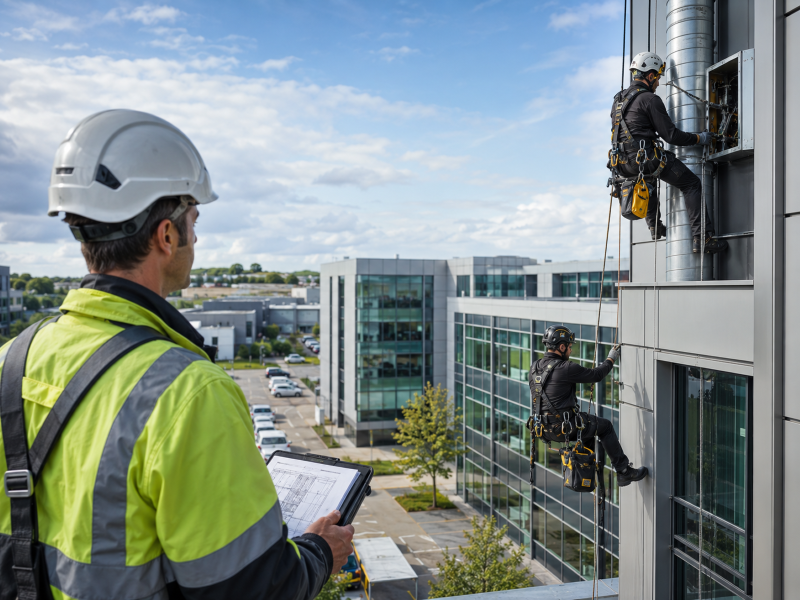
Rope access building maintenance helps commercial building managers manage difficult-access assets across multiple properties without relying on scaffolding or large access equipment for every task. For multi-site estates it can support duct and riser hygiene, access panel installation, compliance audits, high-level inspections, building maintenance, bird control, fall protection system installation and fall protection inspections. The most effective approach is to create a planned maintenance programme that prioritises compliance-critical areas first, then adds wider high-level building works into the same access strategy where practical.
Why rope access building maintenance matters across multi-site estates
Managing one commercial building is demanding. Managing several buildings across different locations, layouts and access challenges is significantly more complex.
Facilities teams may be responsible for office blocks, hospitality sites, education buildings, healthcare premises, residential blocks, retail units, industrial sites or mixed-use commercial properties. Each property may contain ductwork, risers, rooflines, gutters, façades, plant areas, pest-prone ledges and fall protection systems that need inspection, cleaning or maintenance.
The challenge is access.
Traditional access methods can be effective, but they may involve scaffolding design, pavement licences, road restrictions, tenant disruption, long mobilisation times or increased cost. For targeted high-level works, this can make routine maintenance harder to plan.
This is where rope access building maintenance can help. It gives commercial building managers a practical way to inspect, clean, maintain and evidence difficult-access areas with less disruption, especially where the task is focused, high-level or difficult to reach by other methods.
Start with compliance-critical access issues
A strong rope access building maintenance plan should begin with the areas that can affect compliance, reporting and future cleanability.
For many commercial buildings, these include:
- Duct and riser hygiene
- Vertical ductwork inspections
- Access panel installation
- Compliance audits
- Photographic reporting
- No access observations
- Difficult-access ventilation routes
- High-level plant and service areas
These areas matter because incomplete access can create incomplete records. If ductwork, risers or high-level service routes cannot be inspected or cleaned, facilities teams may be left with unresolved questions about condition, hygiene standards and future maintenance requirements.
Rope Access 24 Seven helps building managers address these problems by providing practical access support for duct and riser hygiene, compliance inspections and access panel installations. This allows previously difficult areas to be assessed, documented and planned more effectively.
How to plan rope access building maintenance across multiple properties
1 Create a property access register
The first step is to understand where the access problems are.
For each property, record:
- Building type
- Number of floors
- Roof access arrangements
- Known difficult-access areas
- Ductwork and riser locations
- Existing access panels
- Previous no access observations
- Known compliance audit issues
- High-level maintenance concerns
- Pest fouling locations
- Fall protection systems
This register gives facilities teams a practical overview of where rope access building maintenance may be needed.
It also helps prevent reactive decision-making. Instead of treating every difficult-access issue as a one-off problem, building managers can start to identify patterns across the estate.
For example, several sites may have similar ductwork access issues, repeated blocked guttering, recurring bird fouling or high-level façade defects. Once these patterns are visible, maintenance can be planned more efficiently.
2 Prioritise duct and riser hygiene
Duct and riser hygiene should sit near the top of the maintenance plan, especially in commercial buildings where ventilation routes pass through vertical shafts, high-level voids or restricted areas.
Difficult-access ductwork can create problems for facilities teams when sections cannot be inspected, cleaned or evidenced properly.
A rope access building maintenance programme can support:
- Rope access duct inspections
- Vertical riser inspections
- Internal ductwork access
- External riser access
- Duct and riser hygiene works
- Access panel installation
- Photographic evidence
- Compliance audit support
- Future cleanability recommendations
This is particularly important where a previous inspection or report has highlighted limited access. Rope access can help teams understand what can be reached, what needs an access panel and what should be planned before the next audit or maintenance visit.
3 Plan access panel installation before future cleaning
Access panel installation is one of the most practical ways to improve long-term maintenance.
If ductwork or risers cannot be inspected properly, facilities teams may repeatedly face the same problem: incomplete access, limited evidence and recurring uncertainty.
A planned rope access building maintenance strategy can identify where access panels may be needed and how they can support future inspections and cleaning.
This may include:
- Reviewing existing access points
- Identifying inaccessible sections
- Planning safe access for panel installation
- Installing panels in difficult-access locations
- Improving inspection routes
- Supporting future cleaning programmes
- Reducing repeated no access issues
- Creating clearer maintenance records
For multi-site estates, access panel planning can be especially valuable. Instead of reacting to each site individually, managers can develop a consistent approach to improving duct and riser access across the portfolio.
4 Use compliance audits to guide the work programme
Compliance audits should not simply identify problems. They should help shape the maintenance plan.
A rope access building maintenance programme can use audit findings to decide which sites need attention first.
Priority may be given to properties where:
- Ductwork access is incomplete
- Risers have not been inspected fully
- Access panels are missing
- High-level areas cannot be safely reached
- Previous reports contain no access notes
- Photographic evidence is limited
- Maintenance teams cannot confirm condition
- High-level defects may affect building safety
- Pest issues are affecting drainage or façade condition
- Fall protection systems need review
This approach helps facilities managers make better use of budgets. The sites with the highest risk, poorest access or weakest evidence can be addressed first, while lower-risk sites can be scheduled into a planned programme.
5 Work with multi-skilled rope access technicians
A strong rope access building maintenance programme depends on more than safe access at height.
Rope Access 24 Seven technicians are IRATA-qualified, but they are not simply abseiling experts providing access for others. They are multi-skilled technicians who understand the specialist work being carried out while providing the rope access service.
This is particularly important for duct and riser hygiene, access panel installation and compliance audits. In these situations, technicians need to understand the asset, the access limitation, the hygiene issue and the reporting requirement.
This means Rope Access 24 Seven can support building managers with practical, informed work at height, including:
- Duct and riser hygiene observations
- Access panel installation support
- Compliance audit inspections
- Photographic reporting
- High-level building maintenance
- Bird control installation support
- Fall protection system installation and inspection
- DOFF cleaning assessments
- Difficult-access cleaning and maintenance recommendations
For commercial property teams this provides a more efficient service. The same team that provides the access can also understand the work scope, identify practical issues, record evidence and recommend next steps.
This helps reduce delays, avoid unnecessary subcontractor coordination and gives facilities managers clearer information from technicians who understand both the access method and the building maintenance task.
6 Group services together where practical
One of the advantages of rope access is that several difficult-access tasks may be reviewed during the same visit, subject to site conditions and safe planning.
A building may initially require duct and riser hygiene support, but the same access assessment may also identify high-level building maintenance issues, blocked guttering, bird fouling, façade staining or fall protection concerns.
A coordinated rope access building maintenance plan may include:
- Duct and riser hygiene
- Access panel installation
- Compliance inspections
- Façade inspections
- Gutter and drainage checks
- High-level cleaning
- Bird control surveys
- Bird netting and spiking advice
- Fall protection system inspections
- Fall protection installation planning
- DOFF cleaning assessments
- General building maintenance observations
By grouping compatible services into one access strategy, facilities teams can reduce repeated site disruption and improve the value of each visit.
7 Build maintenance around the needs of each property
No two commercial buildings are exactly the same.
A high-rise office block, hotel, school, care home, shopping centre, residential block and industrial site will each have different access challenges.
A strong rope access building maintenance plan should consider:
- Building height
- Public access areas
- Tenant occupancy
- Operational hours
- Service entrances
- Roof access restrictions
- Plant locations
- Ductwork layout
- Façade material
- Pest pressure
- Local environment
- Maintenance history
- Compliance priorities
This is where a personalised approach matters. Rope Access 24 Seven can help building managers review each property individually while still creating a consistent maintenance strategy across the wider estate.
Why duct and riser hygiene should be a priority
Ductwork and risers are often hidden from view, which makes them easy to overlook.
However, these systems may be central to building hygiene, ventilation performance, fire safety planning, kitchen extract maintenance, air movement and wider compliance records.
Where sections cannot be accessed, facilities teams may be unable to confirm the condition of the system.
Prioritising duct and riser hygiene within a rope access building maintenance programme helps building managers:
- Understand hidden asset condition
- Improve access for future inspections
- Reduce uncertainty in compliance audits
- Plan access panel installation
- Support cleaning evidence
- Identify design or access limitations
- Avoid repeated incomplete reports
- Strengthen maintenance planning
For commercial estates this can make a significant difference. A site with better duct access is easier to inspect, easier to maintain and easier to evidence.
Why technical skill matters during rope access building maintenance
Rope access is the method of reaching the work area, but the value of the service depends on what happens once the technician is there.
For commercial building managers this distinction matters. A technician working at height may need to inspect a riser, identify a missing access panel, assess a hygiene limitation, photograph a defect, install bird control measures, review a fall protection system or advise on a maintenance issue.
That requires more than rope access competence alone.
Rope Access 24 Seven provides technicians who are trained for work at height and experienced in the practical services being delivered. This supports better decision-making on site because the technician can understand both the access challenge and the maintenance objective.
For rope access building maintenance this is especially valuable where sites need clear observations, sensible recommendations and evidence that can support future planning.
How rope access supports high-level building maintenance
While duct and riser hygiene may be the priority, rope access building maintenance can also support many wider building needs.
High-level building maintenance may include:
- Façade inspections
- Cladding checks
- Gutter clearance
- Drainage inspections
- Roofline observations
- Sealant checks
- Minor external repairs
- High-level cleaning
- Signage access
- Plant area inspections
- Storm damage reviews
This type of work is important because small defects at height can become expensive problems if they are not found early.
Blocked high-level drainage can contribute to water ingress. Loose fixings can create safety concerns. Stained façades can affect building appearance. Bird fouling can damage surfaces and block gutters.
Rope access gives building managers a way to see and manage these issues before they escalate.
How rope access helps protect appearance and reputation
Commercial buildings are judged from the outside as well as the inside.
Dirty façades, stained stonework, algae growth, blocked gutters, bird fouling and visible defects can make a building look poorly managed.
A planned rope access building maintenance programme can support:
- High-level cleaning
- Façade cleaning assessments
- DOFF cleaning
- Bird fouling removal planning
- Gutter cleaning
- Cladding observations
- Public-facing elevation checks
- Exterior maintenance reporting
For hotels, offices, retail buildings, education estates, healthcare sites and commercial landlords, external appearance can affect reputation, tenant confidence and customer perception.
A cleaner, better-maintained building sends a stronger message about management standards.
How bird control fits into rope access building maintenance
Bird activity can create repeated problems on commercial buildings, particularly where ledges, signs, rooflines, plant areas and high-level façades provide roosting opportunities.
Bird fouling may affect appearance, hygiene, drainage and surface condition.
A rope access building maintenance plan can include bird control surveys and installation support for difficult-access areas.
This may include:
- Bird fouling observations
- Guano-affected area identification
- High-level ledge inspections
- Bird netting installation
- Bird spiking installation
- Drainage impact checks
- Access planning for pest control solutions
- Recommendations for future prevention
Rope access is particularly useful where pest control measures need to be installed at height without large-scale scaffolding.
How fall protection systems should be included
Fall protection systems are essential for safe roof and high-level access.
Across multiple properties, facilities teams may need to manage anchor points, lifeline systems, roof access routes, edge protection and mansafe systems.
A rope access building maintenance programme can help building managers review where fall protection systems are installed, whether they support real maintenance needs and whether inspections or upgrades are required.
This may include:
- Fall protection system inspections
- Anchor point observations
- Lifeline route reviews
- Roof access route checks
- Edge protection observations
- Installation planning
- Maintenance recommendations
- Photographic evidence
This is important because future contractors may rely on these systems when accessing plant, gutters, rooflines or high-level assets. If the system is unsuitable or poorly positioned, maintenance work can be delayed or made more difficult.
How to choose a rope access partner for multiple properties
Choosing the right partner is important when planning rope access building maintenance across a commercial estate.
Facilities teams should look for a company that understands safety, access planning, compliance records and practical building maintenance.
A strong rope access partner should offer:
- IRATA-qualified technicians
- Multi-skilled teams who understand the work being delivered
- Clear communication
- Site-specific planning
- Experience with duct and riser hygiene
- Access panel installation knowledge
- Compliance audit support
- Photographic reporting
- Flexible scheduling
- UK-wide service
- Cost-effective recommendations
- Customer-focused advice
- Free surveys where appropriate
Rope Access 24 Seven supports building managers across the UK with practical rope access services designed around commercial building needs.
The focus is not simply reaching high-level areas. It is helping clients understand the issue, plan the correct solution and maintain their properties more effectively.
Common questions
What is rope access building maintenance?
Rope access building maintenance is the use of specialist rope access techniques to inspect, clean, maintain or support works in difficult-access areas of commercial buildings. It can include duct and riser hygiene, access panel installation, compliance audits, façade inspections, high-level cleaning, bird control and fall protection system inspections.
Why is rope access useful across multiple properties?
Rope access is useful across multiple properties because it can provide a flexible and cost-effective way to manage difficult-access tasks without using scaffolding for every site. It helps facilities teams standardise inspections, reporting and maintenance planning across an estate.
Can rope access help with duct and riser hygiene?
Yes. Rope access can help inspect, access and maintain difficult ductwork and riser areas, especially where previous reports have identified no access issues or where access panels are required.
Can access panels be installed using rope access?
Yes, where the site conditions and installation requirements are suitable. Rope access can support access panel installation in difficult-access ductwork and risers, helping improve future cleanability and inspection access.
How does rope access support compliance audits?
Rope access can support compliance audits by enabling difficult areas to be inspected, photographed and reported on. This gives facilities teams clearer evidence of what has been accessed, what condition it is in and what action may be required.
Are Rope Access 24 Seven technicians only access specialists?
No. Rope Access 24 Seven technicians are IRATA-qualified, but they are also multi-skilled in the work they carry out at height. This means they can support technical tasks such as duct and riser hygiene, access panel installation, compliance inspections, building maintenance, bird control solutions and fall protection system work while providing safe rope access.
Does rope access building maintenance include general building repairs?
Yes. In addition to duct and riser hygiene, rope access building maintenance can support façade inspections, gutter checks, high-level cleaning, minor external repairs, bird control solutions and fall protection system inspections.
When to call Rope Access 24 Seven
If you manage multiple commercial properties and need a safer, more practical way to access difficult areas, Rope Access 24 Seven can help.
Our rope access building maintenance services are designed for facilities managers, building managers, landlords, asset managers and commercial property teams across the UK.
Our priority services include:
- Duct and riser hygiene
- Access panel installation
- Compliance audits
- Rope access ductwork inspections
- Vertical riser access
- Photographic reporting
- No access problem solving
- Future cleanability planning
We also support:
- General high-level building maintenance
- Façade inspections
- Gutter and drainage access
- High-level cleaning
- Bird control solutions
- Bird netting and spiking
- Fall protection system installation
- Fall protection inspections
- DOFF cleaning assessments
Our technicians are IRATA-qualified, but they are also multi-skilled in the services they deliver at height. This includes duct and riser hygiene, access panel installation, compliance inspections, building maintenance, bird control solutions and fall protection system work. Clients benefit from specialist access and practical technical knowledge during the same visit.
Need expert advice across one site or a wider property portfolio?
Contact the Rope Access 24 Seven operations team to arrange a free survey or discuss your maintenance requirements.
📞 Call our Operations Team: 0203 640 8247 to find out more.
📧 Email: info@24sevengroup.co.uk
For information about our full range of services use these helpful website links Rope Access Ductwork, Industrial Rope Access Services, Rope Access Building Maintenance, DOFF Cleaning and Pest Control.
Follow us on Instagram, Facebook and Linked In.